Saturday, November 11, 2006

Product Placement - Nov. 11, 2006


ON SCREEN:

PRODUCT PLACEMENT - AND REMOVAL
ANY DAY; ANY CHANNEL

BOTTOM LINE: DON'T TRUST ANYTHING YOU SEE ON TV ANYMORE
.

Marketing madness

Product placement is bad enough. Now, TV shows are dancing around with product removal, too. How much more are viewers willing to swallow?

By Eric Kohanik

I don’t know about you, but I’m getting more and more weary of TV being nothing but one big commercial.

Product placement is a big culprit behind this feeling. Any time a brand nameor company logo pops up in a show, you can bet your grandmother’s pension some company has paid to have it there.

It might be the bottle of beer a character asks for. Or it might be a car that shows up just a little too prominently in a scene.

The sports world has long been a den of such prostitution, of course. Just look at the boards at any National Hockey League game, or the playing surface – and even the players’ jerseys – in a Canadian Football League telecast. The world of auto racing? Don’t get me started on that.

TV dramas and sitcoms used to be above such whoring. But not anymore. The increasing use of PVRs/DVRs that allow viewers to skip through commercials has prompted marketers and advertisers to find “new” and “innovative” ways to rub our noses in their logos during the actual shows.

Product placement isn’t “new” or “innovative,” of course. In the early 1980s, when Steven Spielberg was making ET: The Extra-terrestrial, the script called for the cuddly alien to develop a sweet tooth for a certain candy. Spielberg wanted to be realistic and use M&Ms, but the company that makes them wouldn’t give its permission.

So, Spielberg’s crew went to the folks who made Reese’s Pieces. When the movie came out, sales of that candy skyrocketed.

Now, companies actually PAY to have theirproducts show up in movies and TV shows. Even TV commercials are starting to do some weird double-dipping, placing one company’s product within another company’s ad.

It’s not only the product placements that bug me more and more these days. There’s a product REMOVAL that is also starting to stick out like a sore thumb.

It happens when a producer hasn’t been able to get a company to pay to have its product on a show. And so, familiar-looking beer cans are suddenly altered to just say “Beer” on them; pop cans just say “Cola.”

What’s really bad, though, is how shows are now starting to pixellize logos to make them fuzzy and unidentifiable, just because nobody paid to get that logo into a shot.

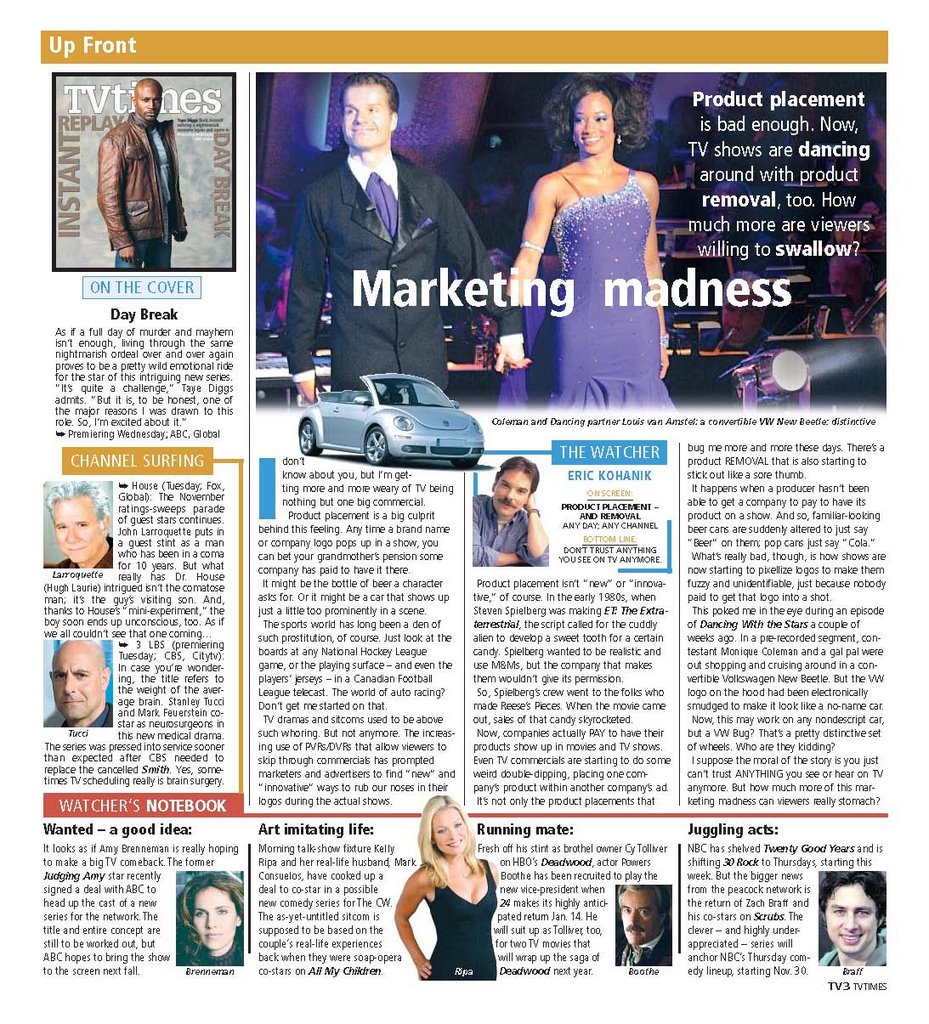
This poked me in the eye during an episode of Dancing With the Stars a couple of weeks ago. In a pre-recorded segment, contestant Monique Coleman and a gal pal wereout shopping and cruising around in a convertible Volkswagen New Beetle. But the VW logo on the hood had been electronically smudged to make it look like a no-name car.

Now, this may work on any nondescript car,but a VW Bug? That’s a pretty distinctive set of wheels. Who are they kidding?

I suppose the moral of the story is you just can’t trust ANYTHING you see or hear on TV anymore. But how much more of this marketing madness can viewers really stomach?

Saturday, November 04, 2006

Devil's Brigade - Nov. 4, 2006


ON SCREEN:

DEVIL'S BRIGADE
TUESDAY AND WEDNESDAY; HISTORY TELEVISION (CANADA)

BOTTOM LINE: LEST WE FORGET
.

The Power of The Force

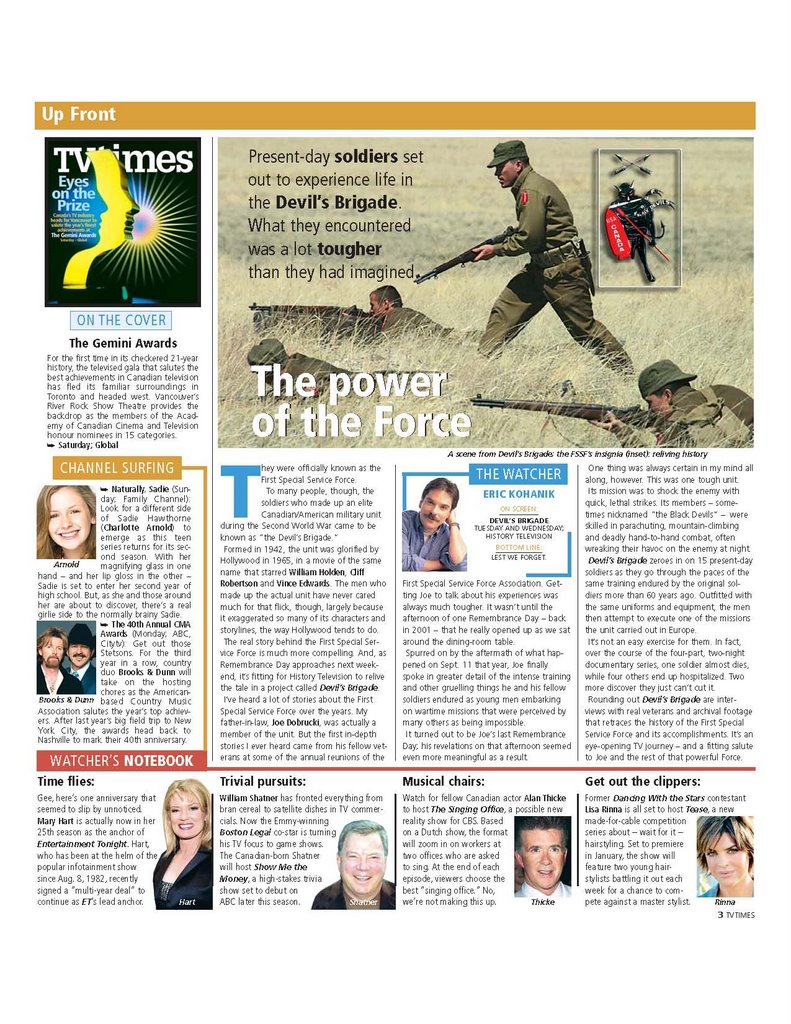
Present-day soldiers setout to experience life in the Devil’s Brigade.What they encountered was a lot tougher than they had imagined.

By Eric Kohanik


They were officially known as the First Special Service Force.

To many people, though, the soldiers who made up an elite Canadian/American military unit during the Second World War came to be known as “The Devil’s Brigade.”

Formed in 1942, the unit was glorified by Hollywood in 1965, in a movie of the same name that starred William Holden, Cliff Robertson and Vince Edwards. The men who made up the actual unit have never cared much for that flick, though, largely because it exaggerated so many of its characters and storylines, the way Hollywood tends to do.

The real story behind the First Special Service Force is much more compelling. And, as Remembrance Day approaches next weekend, it’s fitting for History Television to relive the tale in a project called Devil’s Brigade.

I’ve heard a lot of stories about the First Special Service Force over the years. My father-in-law, Joe Dobrucki, was actually a member of the unit. But the first in-depth stories I ever heard came from his fellow veterans at some of the annual reunions of the First Special Service Force Association.

Getting Joe to talk about his experiences was always much tougher. It wasn’t until the afternoon of one Remembrance Day – back in 2001 – that he really opened up as we sat around the dining-room table.

Spurred on by the aftermath of what happened on Sept. 11 that year, Joe finally spoke in greater detail of the intense training and other gruelling things he and his fellow soldiers endured as young men embarking on wartime missions that were perceived by many others as being impossible.

It turned out to be Joe’s last Remembrance Day; his revelations on that afternoon seemed even more meaningful as a result.

One thing was always certain in my mind all along, however. This was one tough unit.

Its mission was to shock the enemy with quick, lethal strikes. Its members – sometimes nicknamed “the Black Devils” – were skilled in parachuting, mountain-climbing and deadly hand-to-hand combat, often wreaking their havoc on the enemy at night.

Devil’s Brigade zeroes in on 15 present-day soldiers as they go through the paces of the same training endured by the original soldiers more than 60 years ago. Outfitted with the same uniforms and equipment, the men then attempt to execute one of the missions the unit carried out in Europe.

It’s not an easy exercise for them. In fact, over the course of the four-part, two-night documentary series, one soldier almost dies, while four others end up hospitalized. Two more discover they just can’t cut it.

Rounding out Devil’s Brigade are interviews with real veterans and archival footage that retraces the history of the First Special Service Force and its accomplishments. It’s an eye-opening TV journey – and a fitting salute to Joe and the rest of that powerful Force.