Saturday, November 25, 2006

A Charlie Brown Christmas - Nov. 25, 2006


A CHARLIE BROWN CHRISTMAS
TUESDAY; ABC
ALSO DEC. 17 AND 20; YTV (CANADA)


BOTTOM LINE:
A CLASSIC TV TRADITION
.

'Tis the season

A Charlie Brown Christmas is still the holiday special by which all others are measured. It didn’t start out that way.

By Eric Kohanik

Maybe it’s a sentimental thing – you know, something you’ve grown up with and still look forward to every year.

Or maybe it’s just the fact that they don’t make ’em like this anymore.

In either case, when it comes to Christmas TV specials, there’s only one that readers ask me about every year: A Charlie Brown Christmas.

Never mind that you can rent or buy the DVD and watch it any time. It’s that traditional over-the-air TV broadcast that still prompts parents to gather the kids around the tube to watch.

It’s comfort television.

It was back on Thursday, Dec. 9, 1965, that viewers got their first look at A Charlie Brown Christmas. And when cartoonist Charles M.Schulz had good ol’ Charlie Brown and the rest of his Peanuts pals seek out the true meaning of Christmas, little did he know that the result would be a holiday special by which all others would be measured.

It’s funny how a mid-1960s saga of a little bald-headed kid and his animated friends still captures everyone’s imagination today. In fact, it didn’t look that way at first.

Network executives at CBS, where the show originated, were mortified by the final product that was delivered to them. They were convinced it would bomb.

The fact that the debut telecast was going to pre-empt Gilligan’s Island didn’t please them, either. Nevertheless, A Charlie Brown Christmas was an instant hit and would become the first of many more Peanuts specials. And, although it may not be the most polished of the bunch, many say it’s the best.

What makes A Charlie Brown Christmas continue to twinkle is more than its simple storyline or its crudely animated characters. Schulz had recruited an American jazz musician named Vince Guaraldi to come up with the soundtrack for the special.

Guaraldi created memorable arrangementsof such songs as Christmas Time Is Here and wrote what would become a signature Peanuts tune, a jazzy little piano number called Linus and Lucy.

As for the TV production itself, that was digitally remastered to spruce it up for a 40th-anniversary telecast last year. The result was a surprisingly vibrant reawakening.

For many years, it was an annual fixture on CBS in the United States and CBC in Canada. That all changed a few years ago, when ABC managed to grab the broadcast rights in the U.S., while YTV snagged the Canadian ones.

This year, viewers will actually have several chances to catch A Charlie Brown Christmas. ABC rolls out its telecast Tuesday night. YTV will wait a little longer, airing it Dec. 17 and then again on the 20th.

And, of course, there’s always the DVD.

Saturday, November 18, 2006

Seinfeld - Nov. 18, 2006


ON SCREEN:

SEINFELD: SEASON 7
AVAILABLE TUESDAY ON DVD


BOTTOM LINE:
THERE'S STILL A LOT MORE TO THIS SHOW THAN ALL THAT YADA, YADA, YADA
.

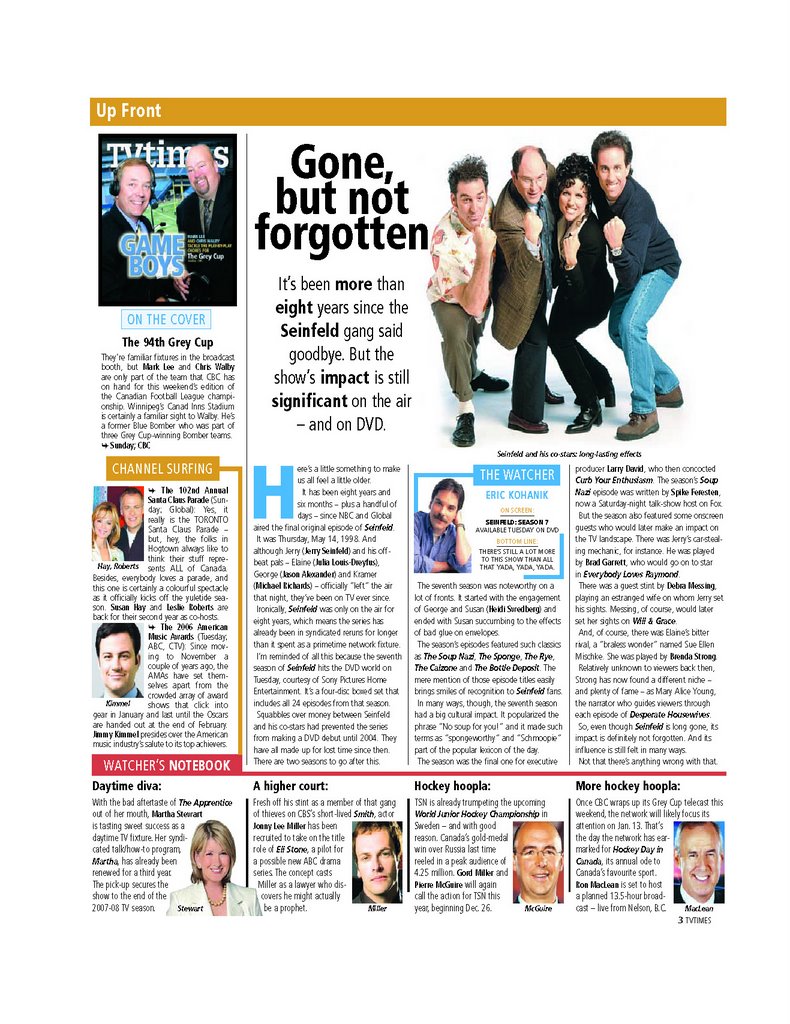
Gone, but not forgotten

It’s been more than eight years since the Seinfeld gang said goodbye. But the show’s impact is still significant on the air– and on DVD.

By Eric Kohanik

Here’s a little something to makeus all feel a little older.

It has been eight years and six months – plus a handful of days – since NBC and Global aired the final original episode of Seinfeld.

It was Thursday, May 14, 1998. And although Jerry (Jerry Seinfeld) and his offbeat pals – Elaine (Julia Louis-Dreyfus), George (Jason Alexander) and Kramer (Michael Richards) – officially “left” the air that night, they’ve been on TV ever since.

Ironically, Seinfeld was only on the air for eight years, which means the series has already been in syndicated reruns for longer than it spent as a primetime network fixture.

I’m reminded of all this because the seventh season of Seinfeld hits the DVD world on Tuesday, courtesy of Sony Pictures Home Entertainment. It’s a four-disc boxed set that includes all 24 episodes from that season.

Squabbles over money between Seinfeld and his co-stars had prevented the series from making a DVD debut until 2004. They have all made up for lost time since then. There are two seasons to go after this.

The seventh season was noteworthy on a lot of fronts. It started with the engagement of George and Susan (Heidi Swedberg) and ended with Susan succumbing to the effects of bad glue on envelopes.

The season’s episodes featured such classics as The Soup Nazi, The Sponge, The Rye, The Calzone and The Bottle Deposit. The mere mention of those episode titles easily brings smiles of recognition to Seinfeld fans.

In many ways, though, the seventh season had a big cultural impact. It popularized the phrase “No soup for you!” and it made such terms as “spongeworthy” and “Schmoopie” part of the popular lexicon of the day.

The season was the final one for executive producer Larry David, who then concocted Curb Your Enthusiasm. The season’s SoupNazi episode was written by Spike Feresten, now a Saturday-night talk-show host on Fox.

But the season also featured some onscreen guests who would later make an impact on the TV landscape. There was Jerry’s car-stealing mechanic, for instance. He was played by Brad Garrett, who would go on to star in Everybody Loves Raymond.

There was a guest stint by Debra Messing, playing an estranged wife on whom Jerry set his sights. Messing, of course, would later set her sights on Will & Grace.

And, of course, there was Elaine’s bitter rival, a “braless wonder” named Sue Ellen Mischke. She was played by Brenda Strong. Relatively unknown to viewers back then, Strong has now found a different niche –and plenty of fame – as Mary Alice Young, the narrator who guides viewers through each episode of Desperate Housewives.

So, even though Seinfeld is long gone, its impact is definitely not forgotten. And its influence is still felt in many ways.

Not that there’s anything wrong with that.